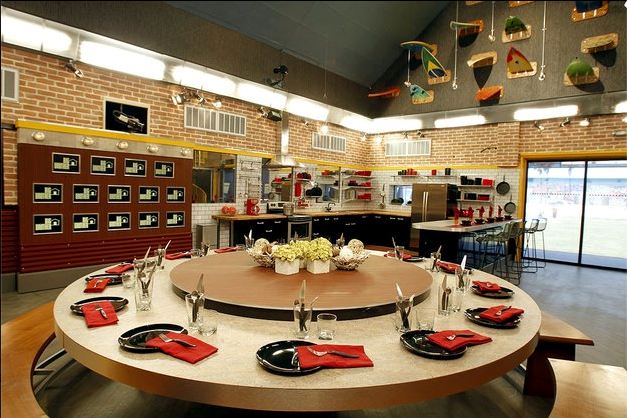
There is a wall in the Big Brother kitchen with everybody’s face on it. While you are in the game your face is in colour. The night you leave, it turns black and white, and it stays that way until the season ends. It is the simplest idea in the show and the houseguests cannot stop looking at it.
- What it is: A display of every houseguest’s portrait, in the kitchen, visible from most of the house.
- The rule: Colour means you’re still playing. Black and white means you’re out. That’s the whole system.
- When it changes: Live, during the eviction show, seconds after the front door closes.
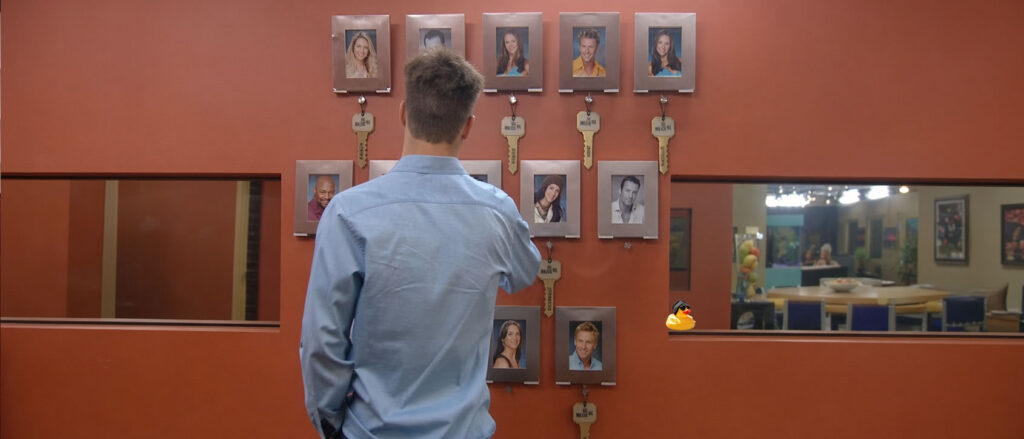
- The keys: Hung under the portraits for roughly fifteen years. Gone since Big Brother 19.
- Why they stare at it: It’s a study guide. Late-season competitions are built out of these faces.
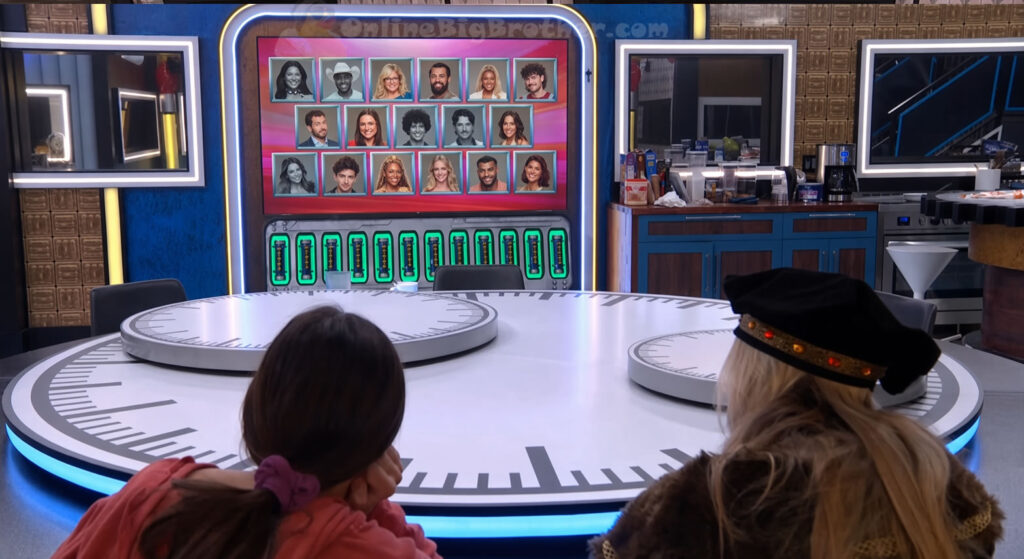
- Right now: Big Brother 28 runs one continuous screen with 17 portraits and no keys.
How the Memory Wall Works
The Memory Wall sits at the kitchen end of the main room, where everybody walks past it forty times a day. Every houseguest gets a portrait, shot before they move in, all lit the same way against the same background so the set reads as a single grid.
Colour means you are in the game. Black and white means you are not. There is no third state — jury members look exactly like pre-jury evictees, and the wall does nothing special to mark the difference. In Big Brother 13, Porsche noticed the entire middle row happened to be people sitting in the jury house. Rachel said she’d never noticed. Porsche knew because she knew who they were, not because the wall told her.
What makes it more than décor is that it is also the season’s answer key. Late-game competitions — the morph comps, the before-and-afters, the memory quizzes — are built out of exactly these faces and exactly this running order. So houseguests stand in front of it for hours, memorising the order people left, the spelling of surnames, the colours in the background of each portrait. It’s the only piece of furniture in the house that will win you the game.
Going Black and White
The short answer
It happens live, on air, while the eviction show is still running — usually within seconds of the evictee walking out the front door.
The houseguests are standing right there watching it happen. It has never been an overnight change.
Big Brother 16 gives the cleanest proof, because Julie said it out loud. Frankie had already left the house and was sitting outside with her when she told him:
Julie Chen Moonves, Big Brother 16
“Your picture is now black and white.” … “There it goes.”
She was narrating it in real time. Production was flipping the wall while the show was still on the air. It works the same way inside — Big Brother 24, after Indy left: “Back inside, there was complete silence as they watched her pic go black and white.”
It is enough of a fixed beat that its absence is noticeable. At the Big Brother 24 finale, in the gap where the evictee’s photo normally greys out, the broadcast cut to Monte and Taylor hugging instead.
Unless you didn’t get evicted
Everything above applies to a normal eviction. Anything else — a walkout, an expulsion, a twist — and the wall lags, sometimes for a whole day. Every one of those lags has turned into a story, because the houseguests read the wall as an official document and start reasoning from it.
The best example is Big Brother 11, after Chima was expelled. Her photo sat there in colour for hours while the house tried to work out what had happened:
“What’s really weird is her picture isn’t grayed out.”
“Well she wasn’t evicted.”
That is a houseguest stating the rule out loud, correctly, in the middle of the one situation the rule doesn’t cover. Chima’s portrait didn’t turn until the afternoon.
Big Brother 13 was worse. Evel Dick left the house in the middle of the night and his portrait stayed in colour — and his key stayed in its slot — for more than a day. Feed watchers used both as evidence he was coming back. His photo finally went black and white after that week’s veto competition, which is to say: when production was ready, not when he left.
And sometimes it comes back
Win your way back into the game and your portrait is restored to colour. It is documented three times over: Big Brother 13, when Brendon returned — “Brendon’s picture on the memory wall is back to color,” with Jordan noticing the middle row was solid again. Big Brother 16, when Nicole came back through the jury buyback. And Big Brother 20, when Scottie won the Battle Back and went and stood in front of his own portrait to look at it in colour.
A small, sad footnote. David was the first person evicted in Big Brother 21, so his portrait was grey within a week and stayed that way all summer. When he came back for All-Stars the following year, he stood at the Big Brother 22 wall and said it was the first time he’d ever seen his own picture in colour.
Every Version of the Memory Wall
The wall is rebuilt with the house every year, but it has only really changed shape four times. Almost everything written about this online says it went from printed photographs to screens in Big Brother 16. That isn’t what happened.
The screens arrived far earlier than anyone says
Big Brother 16 is when the wall became two big LCD panels. It is not when the wall stopped being photographs. Production designer Scott Storey said so himself at the time, and the phrasing is the tell:
Scott Storey, June 2014
“The Memory Wall, now two rectangular 65” LCD HD screens with key holes running on each side for the houseguests. Because we’re in HD, we were able to change up the technology.”
Change up, not replace. He is upgrading an electronic wall that was already electronic, and the live feeds had been proving it for years:
- 2005 — coverage of Big Brother 6 describes the wall of photos as, in as many words, screens.
- 2006 — George goes down the Big Brother 7 wall poking every portrait, “making the screens ripple.” Paper doesn’t ripple. Neither does an LCD.
- 2007 — the whole wall swaps from houseguest portraits to competition photographs for a Big Brother 8 HOH comp, then swaps back.
- 2008 — “the photo wall lit up with pics from some of the season’s comps.”
- 2010 — a power cut takes out the Big Brother 12 house and a houseguest reports that “the memory wall was off… everything was off.”
- 2011 — Evel Dick’s already-blacked-out portrait vanishes overnight. Adam touches the panel and it comes back. “I’ve got elvin magic in my fingertips. And Dick’s back!”
So the honest version is that the individual-screen wall was running by Big Brother 6 in 2005, roughly a decade before the change everybody credits. What Big Brother 16 did was collapse fourteen or sixteen little displays into two big ones.
When the maths didn’t work
Because the old wall had a fixed number of physical positions, the count occasionally didn’t match the cast — and every time it didn’t, the house noticed and started theorising.
- Big Brother 10, 11 and 12 — fourteen positions, thirteen houseguests. The spare position in the middle showed the Big Brother logo, and it had a working key slot underneath it, which drove a season-long theory that a fourteenth player was hiding somewhere. Dan: “There is a reason for that… Maybe someone has been hiding in the wall the whole season.” Jerry, less convinced: “This board was made for us.”
- Big Brother 14 — the wall spoiled the season’s biggest twist. At 3:20 in the morning Willie stood in front of it, counted the key holes next to the coaches’ faces, and worked out that the coaches were going to enter the game. Dan, separately and just as bluntly: “Why do we have key slots then?”
- Big Brother 17 — seventeen people played but only sixteen positions existed, so when Julia became her own player, production gave her Jace’s position. The first evictee was quietly written over.
- Big Brother 25 — the wall simply wasn’t switched on for the opening stretch of the season, and only came up once the cast had settled at sixteen.
- Big Brother 27 — the opposite problem. Seventeen players, eighteen positions, and one frame sat empty on the feeds all season. Fans were certain it meant an eighteenth houseguest was coming. It didn’t. It stayed empty.
One genuine unresolved conflict: Big Brother 9. The standing account is sixteen houseguests crammed against fourteen positions, solved by leaving the portraits off the wall for the first week. But this site’s own founder, writing in July 2008 about the season that had just finished, said flatly that BB9 had sixteen houseguests and a sixteen-space wall. Both can’t be right. We’re going with the contemporaneous version and flagging it rather than quietly picking one.
The Keys
For most of the show’s life the Memory Wall was not only a scoreboard. It was a rack. Under every portrait hung that houseguest’s key, on a string, and the keys were the machinery of the whole nomination ceremony.
The way it worked: the Head of Household pulled the keys of everyone who was safe, one at a time, out of a rotating box. Whoever’s key never came out was nominated. Afterwards the safe houseguests’ keys went back into their slots in the wall — which meant that anyone watching the feeds could see the nominations before a word was spoken.
How feed watchers spoiled the noms, 2009
“Looking at the memory wall on feed 4 earlier in full screen, you can clearly see NO keys under Scrappy or Kevin’s pics. They are the nominees.”
The order the keys came out mattered enormously, because it was the only editorial the HOH got. Last key out was the person you were sweating. Houseguests planned the sequence in advance like a set list. Jeff, in Big Brother 13, working it out with Jordan beforehand:
“Just so you know with the keys, I’m gonna give Rachel hers first, then you…”
“So she’ll feel special.. I don’t care..”
“I gotta do Daniele’s last to build some tension.”
Jordan, another season, on her own running order: she left Russell’s key for last because he was so paranoid. Aaryn, watching someone else do it in Big Brother 15, delivered the review: “She wasn’t very strategic with her keys. It was totally in order of who she likes.”
They were physical objects and they behaved like it. One turned up at the bottom of the pool in Big Brother 9. In Big Brother 10, Ollie had a meltdown and ripped every single key out of the wall on his way through the house, punching a portrait as he went — Dan, watching on the HOH monitor: “Hey.. my picture’s messed up. Did he punch my picture?” Keesha: “Duuuude. Is he allowed to do that?”
They also came with a sound effect. , Big Brother 13: “Every Sunday I get a little thrill when I hear the SHWINNNGGG sword sound effect when they pull out their keys from the box.. they’re plastic, aren’t they?”
And then they were gone
The keys survived the jump to LCD screens in Big Brother 16 — Storey’s own description has “key holes running on each side,” and feed watchers were still reading nominations off the wall that September.
They did not survive Big Brother 19. The house reveal in June 2017 noted it in seven words: “Memory Wall but sadly no key slots.” There was no announcement, no explanation, and no farewell. They have never come back.
Nine seasons later, the show seems to know what it lost. A Big Brother 26 competition ran a montage of nostalgia references — old catchphrases, old running jokes — and slipped in “the old nomination key wheel” alongside them, a retired prop played for recognition.
The one place keys survive is the finale. Every year the jury still walks up and puts a physical key into a round slotted box, and Julie still pulls them out one at a time to read the votes. That ritual is unbroken from at least 2008 to the present, and it is the last working piece of the original key furniture anywhere in the show.
Life at the Memory Wall
It is the one place in the house where standing still and saying nothing is normal behaviour, which makes it the closest thing Big Brother has to a chapel.
Ivette, pointing at Janelle’s portrait, in the tone of someone who has just lost: “I never seriously thought this picture would go black & white at some point.”
Jen spent a good chunk of the season complaining about the portrait production had picked for her, calling it “the ugliest picture I’ve ever seen.” Nobody has ever established whether houseguests get any say in the shot.
Renny was caught doing impressions of everybody’s portrait — by Jerry, who was one of them. “I was mocking everybody,” she said, which did not help. The same season, Memphis attached a badminton net to the Memory Wall and got shut down instantly: “BB: Memphis, Stop that!”
Jordan, studying: “I do like Lydia’s picture in black and white. Jeff, your picture looks like a soap opera.” Later, less warmly, about a houseguest she wanted gone: “Every time I look at his picture on the wall with that smirk… I can’t wait to see his picture go black and white.”
While Adam napped, the house removed all the keys, taped over his portrait so it looked like he’d been evicted, and had Kalia scream to wake him. They hid in the HOH room watching him on the spy screen. He peeled the tape off without breaking stride.
GinaMarie was caught kissing her showmance’s blacked-out portrait. Aaryn used the wall as a calendar — “One more black and white picture, and we’ll be in the final half” — and as a threat: “Whenever Elissa’s photo goes dark, you’re gonna be alone.”
Cody, bluffing about how much work he’d put in: “I never looked at the memory wall. I never looked at that thing. I didn’t look at the people on the wall. I walked by it.” He had absolutely looked at the wall.
Keanu, alone at the wall after losing his closest ally, quietly, to a photograph: “I can’t believe you’re gone, supposed to be me and you in the final two seats.”
And the most quietly devastating line about the whole thing came from Ian at the final four in Big Brother 14, looking at a wall that was almost entirely grey: “Isn’t it nuts to see your picture there in color with a key?”
The staring is often production’s idea
Some of the wall-gazing you see on the broadcast is real. A lot of it is a pickup shot. Dan let this slip on the feeds in Big Brother 10 and was cut off mid-sentence:
Big Brother 10, on the live feeds
Dan: “They had me stare at the memory wall for ten minutes.”
Big Brother: “Dan, you are not allowed to talk about production.”
Feed watchers clocked the pattern years ago, and got sick of it. One in 2009: “all those little shots they have each week like the HoH mulling over the keys or the veto winner looking at the memory wall as if they’re making a last minute decision. I love my BB but stuff like that is too much cheese!”
When the Wall Gets It Wrong
It is a screen the size of a wall running live in front of a studio audience, so occasionally it misbehaves.
The best-documented error was in Big Brother 23, and we know about it because the host said so. When Sarah Beth was evicted, Azah’s portrait went black and white at the same time — and Azah was still very much in the game. Julie afterwards: “I think when Sarah Beth’s memory wall photo went black and white so did Azah’s by mistake.”
The hardware fails too. In Big Brother 23 the entire left-hand side of the wall went dark and the feeds were cut for a morning while it was repaired; the photo wall spent the rest of that season on running list of broken things in the house, alongside the coffee maker and a kitchen cabinet. In Big Brother 27 the production-goofs tally simply records entry 82: “Photo wall freaked out.”
Which is, in its way, the clearest evidence of what the thing actually is. A photograph doesn’t freak out.
Who Builds It
The Memory Wall is inside the house, which puts it in Scott Storey’s department — he has been Big Brother’s production designer since 2005, builds the house on half a soundstage at CBS Radford, and tears most of it down and rebuilds it every year. The backyard competitions belong to a separate team under Narbeh Nazarian; the wall does not.
That is where the trail stops. Storey has given plenty of interviews — about themes, budgets, build times, camera sightlines, how he stops houseguests cheating — and in none of them has anybody asked him about the Memory Wall. His 2014 description of the two 65-inch panels is the only time he is on record about it at all, and it is two sentences long.
Nobody has ever been credited for the wall’s display system, nobody has been named as its fabricator, and there is no public account of how it is actually updated — whether somebody drives it from the control room, or it runs off a cue like everything else in a live show. For an object that has been on screen in every episode for twenty-four years, that is a strange amount of nothing.
The portraits themselves are shot before move-in, at the pre-season photo session, with each houseguest photographed alone under enough security that they don’t meet the rest of the cast. That much is consistent across accounts. Which specific photographer takes the shot that ends up on the wall has never been confirmed.
The Wall in Big Brother 28
The Time Trip house has quietly retired the design that ran for twelve years. Where Big Brother 16 through 27 had two clearly separate framed panels, Big Brother 28 has one wide, continuous display surface in the kitchen, with the portraits drawn as tiles across it and no visible seam.
It carries seventeen portraits for this season’s seventeen houseguests — fourteen announced, plus Rick Devens, Dee Valladares and returning Big Brother 26 player Angela Murray. There are no key slots, and there haven’t been since 2017.
It is still in the kitchen, where it has been for as long as anyone has been writing this down, and it is still doing the one job it has always done. From the feeds on July 28: “12:40am Kitchen — Mallory and Barrett checking out the memory wall.”
A note on what we’re not claiming: the BB28 wall looks like a single continuous screen, and that’s how observers described it at the house reveal. Whether there is genuinely one panel behind the surround or several tiled to look seamless, CBS has not said and we haven’t found out.